
Table of Contents
- Natural Wax vs Paraffin Candles: The Quick Comparison
- Are Paraffin Candles Safe to Burn at Home?
- Which Candle Wax Has the Best Scent Throw?
- Which Candle Wax Burns Longest?
- How to Choose Sustainable Candles Without Falling for Greenwashing
- Natural Wax vs Paraffin Candles: Pros, Cons and Who Each Suits
- Frequently Asked Questions
Last Updated: 18 October 2026
Natural Wax vs Paraffin Candles: The Quick Comparison
Natural wax vs paraffin candles comes down to a simple trade-off: natural waxes such as soy, rapeseed and coconut burn cleaner and come from renewable sources, while paraffin is a refined petroleum by-product that typically costs less and carries fragrance strongly. At Parks Candles, we hand-pour our proprietary natural wax blend, so we have a clear view on where each wax earns its place on your shelf.
Here is the short version. Natural wax wins on indoor air quality and sustainability credentials. Paraffin wins on price and, by some makers' accounts, raw scent intensity. Neither is a safety scandal waiting to happen, despite what you may have read.
| Feature | Natural Wax | Paraffin |
|---|---|---|
| Source | Plant-based, renewable | Refined petroleum by-product |
| Soot | Generally low | Can produce more |
| Scent throw | Good to excellent | Strong, often cheaper to achieve |
| Burn time | Longer per gram | Shorter per gram |
| Cost | Higher | Lower |
| Best for | Clean-burning, sustainable homes | Budget-friendly everyday use |
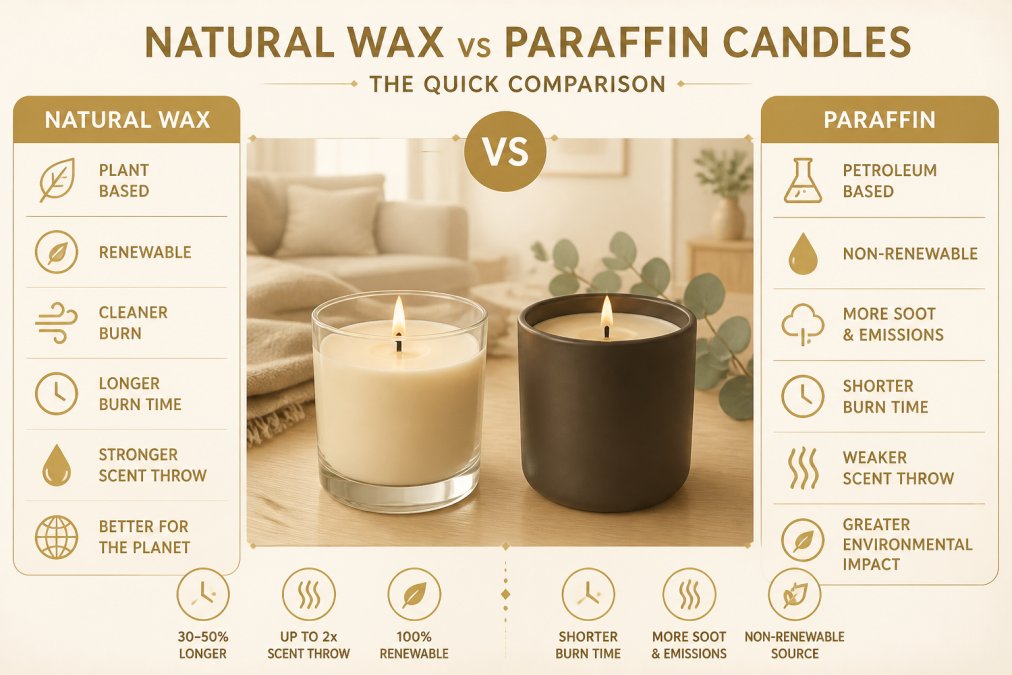
That table is the honest summary. The rest of this guide explains the reasoning behind each row, because the natural wax vs paraffin decision depends on what you value most.
Are Paraffin Candles Safe to Burn at Home?
Paraffin candles are safe to burn under normal conditions, and claims that they are inherently toxic are not supported by the available evidence. CandleScience's analysis of paraffin wax and the science behind the controversy notes that studies have shown paraffin candles are no more "toxic" than candles made with other waxes.
That does not mean all candles are equal. Soot, wick quality and fragrance purity matter more than the wax label alone. A poorly made paraffin candle with a cheap wick will smoke. So will a badly made natural one.
Our practical guidance: keep wicks trimmed to about 5mm, burn in a ventilated room, and never leave a flame unattended. Those habits do more for indoor air quality than swapping wax types ever will. If soot and tunnelling are your real concern, look at how a candle is poured and wicked, not just what it is made from.
Which Candle Wax Has the Best Scent Throw?
Paraffin generally delivers the strongest scent throw per pound spent, which is why it remains common in budget and mass-market candles. Natural waxes have closed much of the gap, and a well-formulated soy or coconut blend can fill a room convincingly.
The nuance most guides miss: wax type is only one variable. Sero Candles' comparison of soy and paraffin performance argues that fragrance purity and wick choice matter more to the final scent experience than the wax itself. We agree with the principle. A premium fragrance oil in a modest natural wax will outperform a cheap oil in expensive paraffin every time.
For a natural wax candle to throw well, it needs the right wick size and a proper cure time. Get those wrong and the scent disappears, which is often what people blame on the wax.
Which Candle Wax Burns Longest?
Natural wax burns longer than paraffin for the same weight of wax. Plant-based waxes generally have a slower melt rate, so a natural wax candle tends to deliver more hours per gram than a paraffin equivalent.
Burn time still depends on vessel diameter, wick size and how you burn it. A wide jar with a single wick will tunnel and waste wax regardless of what it is made from. Our rule of thumb: burn for roughly one hour per 2.5cm of diameter on the first light, then keep sessions under four hours.
If longevity is your priority, a larger vessel with a matched wick and a natural wax blend will serve you better than shopping purely on price per gram.
How to Choose Sustainable Candles Without Falling for Greenwashing
Choosing sustainable candles means checking the whole product, not just the word "natural" on the label. Wax source, fragrance purity, wick material, vessel reusability and how the maker disposes of waste all count.
Use this checklist before you buy:
- Is the wax named specifically (soy, rapeseed, coconut) rather than just "natural"?
- Is the fragrance described as free from phthalates and other restricted materials?
- Is the wick cotton or wood, not metal-cored?
- Can the vessel be reused or refilled?
- Does the maker explain sourcing, or just use green imagery?
For readers who want to see how a plant-based option performs in practice, our Candle wax Sand Pink 250g at £11.99 is a plant-based, fragrance-free way to try candle sand styling.

Natural Wax vs Paraffin Candles: Pros, Cons and Who Each Suits
Natural wax suits anyone prioritising a cleaner burn, renewable sourcing and a longer burn time, and it is our recommendation for most homes. Paraffin suits budget-conscious buyers and those chasing maximum scent intensity at low cost.
Natural wax: pros
- Renewable, plant-based source
- Generally cleaner burn with less soot
- Longer burn time per gram
- Fits sustainable, wellness-focused interiors
Natural wax: cons
- Higher price per candle
- Scent throw depends heavily on formulation and wick
Paraffin: pros
- Lower cost
- Strong, reliable fragrance release
- Widely available
Paraffin: cons
- Petroleum-derived, non-renewable
- Can produce more soot if poorly wicked
- Shorter burn time per gram
Our plant-based candle sand range, including Candle wax Sand Black 250g and Candle wax Sand Green 250g, both £11.99, lets you build a candle in any heat-safe vessel with no melting required.


Frequently Asked Questions
What is the difference between natural wax and paraffin candles?
Paraffin is a by-product of petroleum refining, while natural waxes come from plant or vegetable sources. The practical differences show up in how the candle burns, how it throws scent and how it is disposed of. Paraffin typically costs less and can carry fragrance strongly. Natural wax blends usually burn cooler and more evenly, which reduces tunnelling and soot when the wick is trimmed. Neither type is automatically superior: fragrance quality, wick choice and how the candle is poured matter as much as the wax itself.
Are paraffin candles safe to burn indoors?
Burning any candle indoors produces some soot and combustion by-products, so ventilation and wick trimming matter more than wax type alone. Claims that paraffin is inherently more toxic than other waxes are disputed. Keep wicks trimmed to about 5mm, burn away from draughts and never leave a candle unattended.
Which candle wax has the best scent throw?
Scent throw depends more on fragrance load and wick size than on wax type alone. Paraffin can deliver a strong scent throw and costs less, and fragrance purity and wick choice matter more to overall quality than the wax. A well-made natural wax blend with a correctly sized wick can match that performance, especially in an open-plan room. Ask the maker about fragrance percentage and whether the scent is designed for cold throw, hot throw, or both.
Which candle wax burns longest?
Burn time is driven by wax density, vessel diameter and wick size as much as by wax type. A dense natural wax blend in a narrow vessel often outlasts a wider paraffin pillar of similar weight because less wax is exposed to the flame at once. Look for stated burn times in hours rather than vague claims. Trimming the wick before every burn is the single biggest factor in reaching that figure.
How can you tell whether a candle is made from natural wax?
Check the label for named ingredients rather than marketing words: 'soy wax', 'rapeseed wax', 'coconut wax' or 'plant-based wax blend' are specific, while 'eco-friendly' alone is not. A natural wax candle often sets with a slightly uneven, creamy surface after burning, whereas paraffin tends to cool perfectly flat and glossy. For a verifiable answer, ask the maker for the wax composition and pour origin directly; a brand confident in its sourcing will tell you.
The real challenge is not picking a side in the natural wax vs paraffin debate; it is finding a maker whose formulation and wicking actually deliver on the label. That is where Parks Candles comes in. Our 100% natural wax blend, hand-poured in the UK and developed since 1989, is built for a clean, even burn and a superior fragrance throw, with environmentally conscious sourcing behind every candle. Shop the range and bring a cleaner, longer-burning flame into your home.