


Last Updated: 10 November 2026
Quick Summary
Yes, you can use a candle and reed diffuser together, as long as the two scents share at least one fragrance note. The diffuser provides a steady background scent while the candle adds a warmer burst when lit, so keep one layer subtle and the other stronger.
- Choose scents from the same fragrance family or with one shared note to link them.
- Light the candle for 30 to 60 minutes when you want the room to feel warmer.
- Keep at least a metre between a lit candle and a diffuser, as diffuser oils are flammable.
- Trim the wick to 5mm before every burn and flip the reeds weekly.
- Test the pairing from the doorway and adjust by removing reeds or shortening the burn.
Table of Contents
- Why Candle and Reed Diffuser Scent Combinations Work
- Fragrance Families That Blend Well
- Best Candle and Reed Diffuser Combinations
-
How to Layer Home Fragrance Step by Step
- Step 1: Choose the base scent
- Step 2: Choose a candle with one shared note
- Step 3: Set the diffuser and let it settle
- Step 4: Add the candle and time the burn
- Step 5: Test from the doorway
- Step 6: Adjust, don't add
- Step 7: Re-test over a full evening
- Step 8: Record what worked
- Troubleshooting a pairing that clashes
- Room Size, Airflow and Placement
- How to Make Home Fragrance Last Longer
- Safety When Burning a Candle Alongside a Diffuser
- Shop the Range to Build Your Pairing
- Frequently Asked Questions
Why Candle and Reed Diffuser Scent Combinations Work
A candle and reed diffuser pairing gives you two kinds of fragrance at once: a steady background scent from the diffuser and a burst of warm scent when the candle is lit. At Parks Candles, we have hand-poured fragrance since 1989.
A reed diffuser releases scent continuously, day and night, with no flame. A candle stays quiet until lit, then fills the room with a stronger, warmer throw.
Choosing scents that agree is the key to a considered-smelling room.
Below, we break down how to layer home fragrance so each layer supports the next, and we share the pairings we would pick ourselves.
Fragrance Families That Blend Well
Fragrance families are the broad groups scents fall into, such as citrus, floral, woody and spicy.
Think in terms of fragrance notes: top notes hit first, heart notes sit in the middle, and base notes linger longest.
A warm vanilla, sandal and ylang diffuser, for example, shares a creamy base with amber and woody notes.

Pairing Within a Family
Same-family pairings are the safe route. They smell cohesive and rarely clash.
- Floral with floral: orange blossom with rose or jasmine
- Woody with woody: sandalwood with cedar or vetiver
- Citrus with citrus: bergamot with neroli or grapefruit
If you are new to layering, start here. The margin for error is small.
Pairing Across Families
Cross-family pairings can be striking, but they need a bridge note. The rule we use: one shared note, one contrasting note.
- Citrus candle with woody diffuser: bright top, grounding base
- Floral candle with warm diffuser: soft petals over creamy depth
- Herbal candle with citrus diffuser: fresh and clean without sharpness
Watch out: two strong scents from unrelated families, such as heavy spice and sharp citrus, can turn harsh. Keep one layer subtle and the other stronger.
Best Candle and Reed Diffuser Combinations
The best candle and reed diffuser combinations share a note and split their strength: a diffuser for steady background scent, a candle for warmth when you want it. Rather than a list of one-off examples, use the matrix below to choose a pairing by scent family, room, season and mood, then adjust the intensity to suit the space.
Scent-pairing matrix
| Scent family | Diffuser (base layer) | Candle (lift layer) | Best room | Season | Mood |
|---|---|---|---|---|---|
| Fruity-floral | Wild Fig, Cassis & Orange Blossom | Same scent | Living room | Spring to autumn | Bright, welcoming |
| Warm and woody | Vanilla, Sandal & Ylang | Soft amber | Bedroom | All year | Intimate, calming |
| Fresh and green | Herbal (rosemary, basil or thyme) | Light citrus (bergamot or neroli) | Hallway or kitchen | Spring to summer | Clean, alert |
| Seasonal warmth | Spiced (clove, cinnamon or cardamom) | Woody (cedar or vetiver) | Lounge | Autumn to winter | Cosy, grounded |
| Floral | Rose or jasmine | Orange blossom | Bedroom or bathroom | Spring to summer | Soft, romantic |
| Citrus | Bergamot or grapefruit | Neroli or petitgrain | Study or hallway | All year | Fresh, focused |
| Woody | Sandalwood or cedar | Vetiver or smoky oud | Snug or study | Autumn to winter | Grounded, quiet |
| Herbal | Lavender or sage | Chamomile or light citrus | Bedroom | All year | Restful |
How to read the matrix
Start with the room and the mood you want, then pick the row that matches. The diffuser column is the base layer that runs all day; the candle column is the lift layer you light when you want more presence.
A common pattern is to keep the diffuser in the same family as the room's main purpose and let the candle add contrast.
Matched sets versus mixed pairings
A matched set, such as the Wild Fig, Cassis & Orange Blossom candle and diffuser set, uses the same scent in both formats.

Mixed pairings give you more control.
Watch out: two strong scents from unrelated families, such as heavy spice and sharp citrus, can turn harsh. Keep one layer subtle and the other stronger.
Matching intensity to room and season
A pairing that works in a small snug will overpower a large open-plan kitchen if you use the same number of reeds and the same burn time.
Season matters too. In summer, lighter citrus and floral pairings read as fresh; in winter, the same rooms take warmer spice and wood pairings without feeling heavy.
How to Layer Home Fragrance Step by Step
Layering home fragrance means building scent in stages, from a steady base to a lighter top, rather than lighting everything at once. Follow these steps and you will get a balanced room, not a crowded one.
Step 1: Choose the base scent
Choose the diffuser first. This is the scent that will sit in the room all day, so it should suit the room's main purpose: fresh and green for a hallway, warm and woody for a bedroom, citrus for a study. Decide the base before you buy or light anything else, because every later choice is measured against it.
Step 2: Choose a candle with one shared note
Check the fragrance notes on both products and find the overlap. One shared note is enough to link the two; two shared notes make the pairing safer still. If you cannot find a shared note, choose a candle from a neighbouring family rather than an unrelated one.
Step 3: Set the diffuser and let it settle
Place the diffuser where air moves but not in direct sun, and give it a full day before you judge the pairing. A new diffuser takes time to reach its steady output, and judging it in the first hour will mislead you.
Step 4: Add the candle and time the burn
Light the candle for 30 to 60 minutes when you want the room to feel warmer. Start with the shortest burn that gives you the effect you want, then extend it only if the room still feels flat. The candle is the lift layer, not the main event.
Step 5: Test from the doorway
Sniff from the doorway rather than standing over the products. The doorway is where most people experience the room, and it is the fairest test of balance. If one scent dominates, remove the candle or move the diffuser further away rather than adding more product.
Step 6: Adjust, don't add
More product rarely fixes a clash. Fewer reeds or a shorter burn usually does. If the room still feels crowded, remove the candle entirely for a day and let the diffuser carry the space alone.
Step 7: Re-test over a full evening
Give a new pairing a full evening before you judge it. Scents settle, and the first ten minutes after lighting a candle are not representative of how the room will smell an hour later. Re-test at the same time of day so the comparison is fair.
Step 8: Record what worked
Keep a short note of the pairing, the number of reeds and the burn time that worked in each room. Over a few weeks you will build a personal reference that is more useful than any generic list, because it reflects your room sizes, airflow and preferences.
Troubleshooting a pairing that clashes
If the room smells muddled rather than layered, work through the likely causes in order. First, check whether the two scents share a note; if they do not, the pairing is the problem, not the intensity. Second, reduce the lift layer by shortening the burn or moving the candle further from the diffuser. Third, reduce the base layer by removing a reed or two. Fourth, ventilate the room and re-test after an hour.
Watch out: adding a third fragrance to fix a clash almost always makes it worse. Remove a layer before you add one.
Room Size, Airflow and Placement
Room size and airflow decide how strong a pairing feels. A small candle in a large room will seem weak, while a diffuser in a draughty hallway will fade fast.
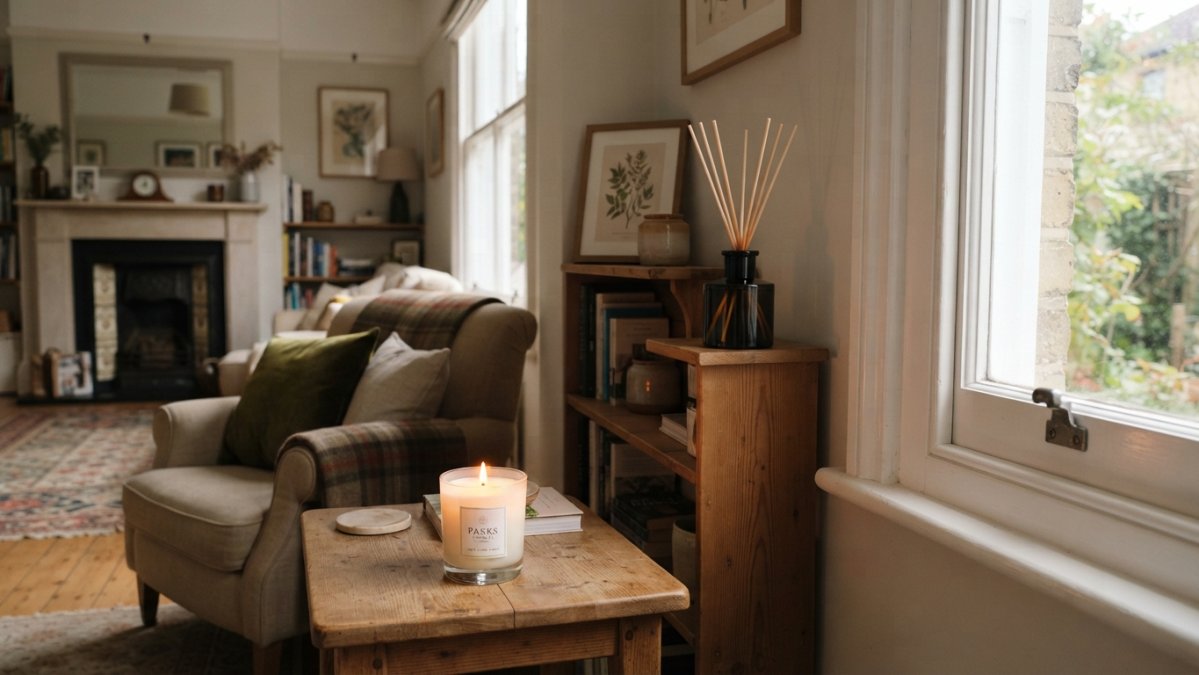
Placement rules we follow:
- Diffusers go at chest height, away from radiators and direct sun. Heat makes them burn through oil too fast.
- Candles go on a stable, heat-safe surface, clear of curtains and shelves.
- Airflow spreads scent. A spot near a doorway carries fragrance further than a corner.
- Small rooms need less. One diffuser is often enough; add the candle only occasionally.
If you want to judge how far a scent will carry, our scent throw guide explains it room by room.
How to Make Home Fragrance Last Longer
You get more from a candle and reed diffuser by looking after both. Small habits stretch burn time and keep the scent steady.
- Trim the wick to 5mm before every burn. A long wick burns hot, smokes and wastes wax.
- Burn for two to three hours at a time. Short burns cause tunnelling; long ones waste wax.
- Flip the reeds weekly. Fresh reeds release more scent.
- Keep diffusers out of direct heat. Heat shortens the life of the oil.
Our guide to preventing candle tunnelling walks through the burn habits that protect your wax.
Safety When Burning a Candle Alongside a Diffuser
Safety comes down to three things: keep the flame clear, keep the oils away from it, and keep the room ventilated. Diffuser oils are flammable, so never place a diffuser close to a lit candle.
- Keep at least a metre between a lit candle and a diffuser.
- Never move a lit candle or leave it unattended (Candle fire safety week: snuff out the fire risk).
- Keep both away from children, pets and soft furnishings.
- Ventilate the room when burning for long periods.
Our tips on burning candles without soot help you keep the air clean when you layer scents.
Shop the Range to Build Your Pairing
Building a pairing starts with one good base scent and one candle that shares a note.
Start with a matched set, then add a second diffuser for another room. Get the pairing right and the whole house smells considered.
Ready to layer your home fragrance properly? Start with a matched candle and diffuser set, then build from there.
Frequently Asked Questions
Can you use a candle and a reed diffuser in the same room?
Yes, and the pairing works well when the two scents are complementary rather than identical. Use the diffuser for a low, continuous background scent and light the candle when you want a burst of fragrance. Keep the diffuser at least a metre from the candle so the flame is not disturbed by air movement, and check that the combined scent does not feel heavy in a small room. Testing for an hour before committing to a full evening is the simplest way to judge it.
Should a candle and reed diffuser have the same scent?
They can, and a matched set makes layering simple because the scent profile stays consistent from room to room. A same-scent pairing is the safest choice if you dislike surprises. If you want more depth, choose two scents from the same fragrance family, such as a woody diffuser with a warm spicy candle. Avoid pairing two very strong, unrelated scents in one room, as they compete rather than blend.
How do you stop layered home fragrance from clashing?
Stick to one dominant note and one supporting note. Citrus and floral work together, as do woody and spicy, but citrus plus heavy musk in a small room often smells muddled. Give each product space: a diffuser in the hallway and a candle in the living room lets the scents meet gradually rather than collide. If a room starts to feel overpowering, remove the diffuser reeds for a day to lower the ambient intensity.
Where should you place a reed diffuser when burning a candle?
Put the diffuser where air circulates naturally, such as a hallway, shelf or windowsill away from direct sun, and keep the candle on a stable, heat-safe surface in the room you are using. A gap of at least a metre prevents the candle flame from being affected by draughts and stops the two scents concentrating in one spot. In larger rooms, placing them at opposite ends gives a more even scent diffusion.
