


Last Updated: November 4, 2026
Quick Summary
To buy sustainable diffusers for your home, choose reed diffusers made from glass, ceramic or responsibly sourced wood, with refillable bottles, recyclable cardboard packaging and reeds you can replace. Check the carrier base and fragrance disclosure before you buy, and separate every component for reuse or recycling at end of life.
- Reed diffusers draw no electricity and contain no plastic reservoir or electronic components.
- Ask makers three questions: the carrier base, whether the fragrance is natural or synthetic, and for an allergen declaration.
- Replace reeds after two to three refills rather than topping up tired, saturated reeds.
- A 100ml bottle suits a bedroom or bathroom, while a 220ml bottle suits a living room or hallway.
- Never pour leftover oil down the sink; seal it in a container for household waste.
Table of Contents
- What Makes a Home Diffuser Sustainable?
- Step 1: Choose Eco-Friendly Reed Diffusers Over Electric Models
- Step 2: Check Natural Reed Diffuser Ingredients Before You Buy
- Step 3: Prioritise Refillable Reed Diffusers for Lower Waste
- Step 4: Look for Eco-Friendly Diffuser Packaging and Recyclable Vessels
- Step 5: Match Scent and Scent Throw to the Room
- Step 6: Maintain Your Diffuser for Longevity and Consistent Scent
- Step 7: Dispose of Your Diffuser Responsibly at End of Life
- Frequently Asked Questions
What Makes a Home Diffuser Sustainable?
Sustainable diffusers are the ones that deliver fragrance with the lowest practical environmental cost across their whole life: what they are made from, how they are refilled, what happens to the packaging, and how they are disposed of at the end. Stopping at the word "natural" is the wrong test.
The market is moving fast. According to Fortune Business Insights' home fragrance market report, the global home fragrance market is projected to grow from £21.5 billion in 2026 to £37.8 billion by 2034. Growth like that invites greenwashing, so the buyer needs a checklist rather than a label.
The definition of "eco-friendly" has stretched to cover almost anything, which is why a checklist matters. Below, we walk through seven steps that separate genuinely low-impact diffusers from marketing. The core test has four parts:
- Materials: glass, ceramic or responsibly sourced wood over single-use plastic
- Refillability: a bottle you top up, not one you bin
- Packaging: recyclable cardboard, no plastic wrap or foam
- End of life: reeds and vessels that can be composted or recycled
Get those four right and the rest of the decision gets much simpler.
Step 1: Choose Eco-Friendly Reed Diffusers Over Electric Models
For most rooms, reed diffusers have a lower environmental cost than plug-in and ultrasonic models. They draw no electricity, contain no plastic reservoir or electronic components, and have nothing to fail and be replaced. A reed diffuser is a passive system: the reeds wick fragrance oil into the air with no power source at all.
That matters more than it sounds. Electric diffusers carry a carbon footprint from manufacture, shipping and daily use, and their plastic tanks and wiring are difficult to recycle at end of life. A glass bottle and a bundle of reeds have a far shorter path back into the material stream.
The trade-off is control. You cannot set a timer on a reed diffuser, and scent throw depends on how many reeds you use. For a bedroom or bathroom, that is rarely a problem. For a hallway, flip the reeds weekly.
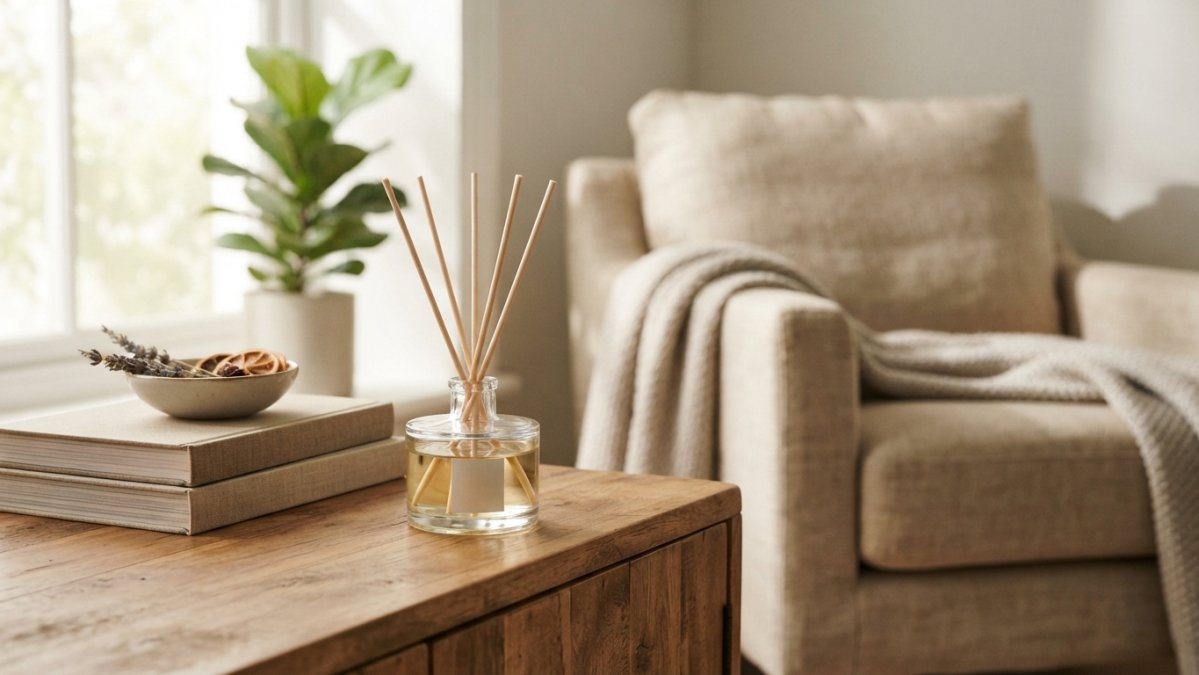
If you want a straightforward starting point, our lavender reed diffuser is a 100ml option for bedrooms and bathrooms.

Step 2: Check Natural Reed Diffuser Ingredients Before You Buy
Read the ingredient list before the fragrance description. When comparing reed diffusers, check the carrier base and whether the fragrance is disclosed. If the label lists "fragrance" with no further detail and no base disclosed, ask the maker directly.
Two terms are worth knowing. Phthalates are plasticising chemicals sometimes used to carry scent; phthalate-free formulas avoid them. Paraben-free means no paraben preservatives, which many buyers now screen for in home fragrance.
Beyond those two, the ingredients most worth screening out of a home diffuser are generally considered to be:
- Alcohol-based carriers, they evaporate quickly, which can make scent throw feel stronger at first but shortens the useful life of the bottle and can be harsh in small rooms.
- Synthetic musk compounds, often listed only as "fragrance", they are persistent in the environment and slow to break down.
- Phthalate plasticisers, used to fix scent to a carrier; avoid where the label is silent.
- Paraben preservatives, common in water-based formulas; not needed in an oil-based reed diffuser.
- Undisclosed "fragrance" or "parfum", a catch-all that can hide dozens of individual compounds.
A practical screening method is to ask three questions of any maker: what is the carrier base, is the fragrance naturally derived or synthetic, and can they supply an allergen declaration.
On natural versus synthetic: natural essential oils are not automatically safer. Tea tree, eucalyptus and citrus oils are natural but can be irritating to pets and small children, and natural oils vary in strength from batch to batch. The sustainable choice is not "natural at any cost" but a transparent, well-documented formula with a carrier that suits the room.
A note on honesty: "non-toxic" is not a regulated claim in the same way as, say, organic food certification. Treat it as a prompt to check the base and the oil source, not as a guarantee.
For a deeper look at clean home fragrance across candles as well as diffusers, our guide to non-toxic scented candles covers what to screen for.
Step 3: Prioritise Refillable Reed Diffusers for Lower Waste
For reed diffusers, one of the main waste decisions is whether the vessel is kept. Refillable reed diffusers let you keep the glass bottle and buy only the oil and reeds.
Reusable vessels also solve a practical problem. A well-made glass bottle with a silver collar looks better on a shelf than a disposable plastic unit, so you keep it rather than hide it. Buy a refill, replace the reeds when they clog, and the same vessel serves for years.
Watch out: reeds stop wicking efficiently once they are saturated with dust and oil, usually after two to three refills. Replace them rather than adding more oil to a tired set, or the scent throw drops and you blame the fragrance.
Step 4: Look for Eco-Friendly Diffuser Packaging and Recyclable Vessels
Eco-friendly diffuser packaging should be recyclable cardboard with paper or moulded pulp inserts. Anything wrapped in plastic film, sat in foam, or boxed with a plastic window is a sign the maker has not thought the lifecycle through.
LAVENDER REED DIFFUSER 100ML →
Check the vessel too. Clear glass is widely recycled and easy to clean out for reuse. Ceramic is durable but harder to recycle locally. Bamboo and responsibly sourced wood are good choices for caps and collars, provided the sourcing is stated.
The guidance from WRAP on UK recycling is a useful check on what your council will actually take, because kerbside rules vary by area. Recyclable on the box does not always mean recyclable at your kerb.
Our diffusers ship in recyclable cardboard packaging.
Step 5: Match Scent and Scent Throw to the Room
Scent throw is the distance and strength a diffuser projects, and it should dictate the size you buy. A 100ml bottle suits a bedroom, bathroom or hallway, and a 220ml bottle suits a living room or hallway.
Fragrance family matters just as much as size. Calming, botanical profiles suit bedrooms and evening routines; fresh, fruity profiles lift a home office or hallway. If you are scenting a bigger space, our nectarine and fig 250ml diffuser gives a fruity profile with more presence, and the 1000ml Secret De Paris diffuser is the option for large rooms that need sustained throw.


| Room | Suggested size | Scent family | Expected duration |
|---|---|---|---|
| Bedroom or bathroom | 100ml | Lavender, camomile | Several months |
| Living room or hallway | 220ml to 250ml | Fruity, floral | Up to 24 weeks |
| Open-plan or large room | 1000ml | Rich, layered | Longest of the range |
Passive reed diffusers are more predictable, but they need reeds flipped weekly to keep performing.
Step 6: Maintain Your Diffuser for Longevity and Consistent Scent
Maintenance affects how long a diffuser keeps its scent. Flip the reeds once a week, use fewer reeds in small rooms for a gentler release, and keep the bottle away from direct sunlight and heat, which degrade the oil.
Place it on a stable surface, away from painted or polished finishes, since spilled oil can mark them. When the level drops, top up rather than shaking the bottle, which only mixes in air.
A common mistake is adding new oil to old, saturated reeds. Start a fresh set of reeds with each refill and the scent throw stays consistent from the first week to the last.
Step 7: Dispose of Your Diffuser Responsibly at End of Life
End of life is where most guides go quiet, and it is where sustainability is won or lost. Very few buying guides explain what actually happens to a diffuser once the oil runs out, so this section walks through each component in turn.
The glass vessel. Empty the last of the oil into a sealed container for household waste, wipe the glass clean with a paper towel, then recycle the bottle at kerbside if your council accepts it. Clear glass is one of the most widely recycled materials in the home, but it must be clean enough not to contaminate the load. If the vessel is decorative and intact, reuse it as a bud vase or a brush pot rather than recycling it, which saves the energy of reprocessing entirely.
The reeds. Fibre and rattan reeds are generally not recyclable and belong in general waste. They are saturated with oil and cannot be composted at home. Do not put them in the paper recycling, as they will contaminate the batch.
The collar and cap. Remove any plastic collar or cap before recycling the glass, and check whether it is recyclable locally. Small plastic components are often missed by kerbside sorters, so separate them at home.
The outer packaging. The cardboard outer goes in paper recycling. Remove any plastic film or foam insert first; if the maker used moulded pulp, that can usually go in with the cardboard.
The oil residue. Never pour leftover oil down the sink. It can coat pipes and is difficult to treat at the water treatment works. Seal it in a container and put it in household waste, or take it to a local household waste recycling centre if your council accepts liquid waste.
A simple rule of thumb: separate every component before it leaves the house, and reuse anything that still has a second life. That single habit does more for the lifecycle impact of a diffuser than any label on the box.
Our 220ml diffusers, including the camomile, violet and orris and lilac formats, use glass vessels, and the camomile, violet and orris diffuser uses recyclable cardboard packaging.
Frequently Asked Questions
What makes a home diffuser sustainable?
A sustainable diffuser combines several factors: a refillable or reusable vessel, natural or responsibly sourced fragrance ingredients, and recyclable packaging. Look for alcohol-free bases, fibre or natural reeds, and glass or bamboo housings that can be refilled rather than replaced. Brands that publish their ingredient sourcing and offer refills make verification easier.
Are reed diffusers better for the environment than electric diffusers?
Reed diffusers use no electricity and release fragrance passively through capillary action. Electric diffusers need power and often plastic or ultrasonic components that are harder to recycle. The trade-off is that reed diffusers have a finite lifespan per fill, so choosing refillable reed diffusers and recycling the glass vessel gives you the lowest-waste option overall.
Can reed diffusers be refilled?
Many can, provided the vessel is sturdy glass and the reeds are replaceable. Refilling extends the life of the vessel and cuts down on packaging waste. Check whether the brand sells refill oils separately and whether the collar or reeds can be swapped. If a refill is not available, the glass bottle can usually be recycled once cleaned, and the reeds composted if they are natural fibre rather than synthetic.
How long does a reed diffuser usually last?
Lifespan depends on size, reed count and room conditions. A 100ml diffuser typically lasts several weeks in a small room, while a 220ml diffuser can run for up to 24 to 40 weeks depending on the formula and how often you flip the reeds. Warm rooms and open windows speed up evaporation, so place diffusers away from direct heat and draughts to get the full advertised duration.
