
Last Updated: 21 November 2026
Quick Summary
You spot fake sustainable candles by testing whether the label names specifics rather than feelings: the exact wax and its percentages, the wick material, the fragrance disclosure and how the packaging is recycled. A vague claim such as eco-friendly or natural-based means nothing in law, so ask the brand in writing and check any certification number with the issuing body.
- Vague terms such as eco-friendly, natural-based and clean burning have no defined meaning in law.
- A 180g candle averaging around 45 hours is a sensible burn time; identical times across every size are not.
- Check a certificate number directly with the issuing body named on the label or website.
- Trim the wick to 5mm before each use for a cleaner flame and less soot.
- The CMA requires environmental claims to be truthful, clear, complete and substantiated.
Table of Contents
- Why Fake Sustainable Candles Are So Hard to Spot
- What Candle Greenwashing Looks Like on a Label
- Sustainable Candle Wax: What the Label Won't Tell You
- Candle Ingredients to Avoid and How to Verify the Rest
- Sustainable Candle Packaging and What Happens After the Burn
- How to Verify Certifications and Environmental Claims
- A Practical Checklist for Judging a Specific Candle
- Choosing a Candle You Can Actually Trust
- Frequently Asked Questions
Why Fake Sustainable Candles Are So Hard to Spot
Learning how to spot fake sustainable candles starts with one uncomfortable truth: candle label wording is largely unregulated.
The difficulty is structural: a candle blends wax, wick, fragrance and packaging, each with its own trade-offs, and a label rarely discloses all four.
Below, we break down the claims that mean nothing, the materials that matter, and a checklist you can apply to any candle before you spend money.
What Candle Greenwashing Looks Like on a Label
Candle greenwashing presents a product as environmentally responsible through vague or unsubstantiated claims, without disclosing the materials that would prove it.
Vague Claims That Mean Nothing
Watch for these phrases. None of them carries a defined meaning in law:
- "Eco-friendly" with no explanation of what makes it eco-friendly
- "Natural-based" rather than "100% natural soy and rapeseed wax"
- "Clean burning" with no mention of wick type or soot testing
A genuine claim names the material, the percentage or the certifying body. A vague claim names a feeling.
Red Flags Checklist for Sustainable Candle Labels
- No wax type stated, or only "natural wax blend" with no components listed
- Burn times that look calculated from wax weight rather than actually tested
- The same burn time quoted across every size in the range
For a deeper breakdown of the specific tricks used on candle labels, see our guide to the most common greenwashing candle tricks.
Sustainable Candle Wax: What the Label Won't Tell You
Sustainable candle wax is a plant-based or responsibly sourced wax whose origin, refinement and burn behaviour the maker can describe in specific terms. The label usually stops at one word. The trade-offs run much deeper, and no single wax wins on every measure.
Why 'Natural' Is Not a Life-Cycle Answer
A wax can be plant-based and still carry a heavy footprint, since growing crops takes land, water and fertiliser, and shipping adds emissions. Paraffin is petroleum-derived and non-renewable. The honest comparison is a set of trade-offs across sourcing, processing, transport, burn and disposal.
Paraffin, Soy, Rapeseed, Coconut and Beeswax Compared
| Wax type | Origin | Sourcing and land use | Processing and transport | Burn behaviour | End of life |
|---|---|---|---|---|---|
| Paraffin | Petroleum-derived | Non-renewable feedstock; extraction impacts are well documented | Refining is energy-intensive but often regional | Strong scent throw; can burn hot if wick is oversized | Residue is not compostable; jar cleaning needed before recycling |
| Soy | Plant-based | Large land footprint; deforestation risk in some supply chains | Solvent or mechanical refining; often shipped long distances | Moderate throw; performance varies by blend and refinement | Residue generally not home-compostable |
| Rapeseed | Plant-based | Grown widely in Europe; rotation crop with lower deforestation risk | Often refined regionally; frequently blended with soy | Good throw when blended; can be soft alone | Residue not home-compostable |
| Coconut | Plant-based | Tropical sourcing; land-use and transport considerations | Usually blended because it is soft alone | Smooth, even burn in a blend | Residue not home-compostable |
| Beeswax | Animal-derived | Renewable but not vegan; apiary welfare and forage availability matter | Low processing relative to plant waxes | Natural scent can clash with fragrance; firm burn | Residue not home-compostable |
| Blended | Mixed | Quality depends entirely on what is in the blend and in what ratio | Varies with components | Can be tuned for throw and even burn | Depends on the dominant wax |
The Questions That Reveal a Real Wax Claim
The most useful question is not 'which wax is best' but 'can the maker tell you exactly what is in the blend and why'. Ask what percentage of each wax is in the blend, where it was grown or refined, and whether the wick was tested against that blend.
Burn Performance Is Part of the Environmental Case
A wax that tunnels or burns unevenly wastes product. A candle that burns cleanly to the edge gets more use from each gram of wax. Compare stated burn time against wax weight, and treat identical burn times across every size as a sign that nobody tested.
For a deeper breakdown of the specific tricks used on candle labels, see our guide to the most common greenwashing candle tricks.
Candle Ingredients to Avoid and How to Verify the Rest
Candle ingredients to avoid are not always dangerous, but they are often undisclosed. The wick and the fragrance are where labels go quiet, and both affect how the candle burns and what it releases into your room.
Wicks, Fragrance and Scent Claims
A wick that is too large burns hot, smokes and wastes wax; one that is too small tunnels and leaves wax stuck to the glass.
On fragrance, look for disclosure rather than poetry. 'Essential oils' is not automatically safer or better, and synthetic fragrance is not automatically worse.
Cold throw and hot throw are different: a candle can smell wonderful unlit and give off almost nothing once burning.
Sustainable Candle Packaging and What Happens After the Burn
Look for specifics. Recyclable packaging means little without knowing which components are recyclable and how. A refillable candle or reusable container extends the product's life, but only if the maker actually offers refills or a clear second use.
End of life is where green claims most often fall apart. A glass jar with a glued-in wick, a plastic lid and a foil seal is technically recyclable and practically awkward.
How to Verify Certifications and Environmental Claims
Verifying a claim takes minutes and separates real brands from careful marketing. The trick is to know what you are verifying. A certification is only as strong as its scope, its independence and your ability to check it, and an environmental claim is only as strong as the evidence behind the specific number or material it names.
What a Certification Actually Covers
A logo on a jar tells you nothing until you know its scope. Some certifications cover a single ingredient, some a manufacturing process, some the whole product. Ask which part of the candle the certification covers, who issued it, and whether the issuer is independent of the brand. A certification issued by the brand itself is a self-created label, not independent verification.
How to Check a Certificate in Practice
Start with the issuing body named on the label or the brand's website. A genuine certificate has a number or reference you can check directly with that organisation, through an online register or by contacting them. If the label shows a logo but no issuing body, no certificate number and no way to verify it, that is your answer.
Testing an Unsubstantiated Percentage
Percentages are where claims most often outrun evidence. '100% natural wax' should be backed by a named composition. '95% recycled packaging' should say which components and what the remaining 5% is. 'Responsibly sourced' should name the source or the standard. When a brand quotes a percentage, ask what it is a percentage of, how it was measured and whether the figure is independently verified or self-reported.
The Law Behind the Claim
Where a claim touches consumer protection law, the Competition and Markets Authority guidance on environmental claims sets out what businesses must be able to substantiate. The CMA's principles require claims to be truthful, clear, complete and substantiated, and they apply to candle brands just as they apply to any other retailer. A brand that can evidence its claims will not mind being asked.
A Five-Minute Verification Routine
- Identify the certification. Note the issuing body and the scope, not just the logo.
- Check the register. Look up the certificate number with the issuing body directly.
- Test the percentage. Ask what the figure is a percentage of and how it was measured.
- Ask the brand. Put the wax, wick, fragrance and packaging questions in writing.
- Compare the answer to the material. A named composition should match the claim on the jar.
If you want to run this routine against real products, a mixed fragrance candle set lets you compare wicks, wax and scent performance side by side before committing to a full-size jar.
A Practical Checklist for Judging a Specific Candle
Use this checklist on any candle before you buy. It works on any brand.
- Read the wax description. Is it specific ("100% natural soy and rapeseed") or vague ("natural-based")?
- Check the burn time against the size. A 180g candle averaging around 45 hours is a sensible figure. Identical burn times across every size are not.
- Look for a stated testing process. Does the maker say the candle was burned through and tested at intervals?
- Ask about the wick. Cotton or wooden, and was it matched to each fragrance?
- Read reviews that describe the lit candle. Scent throw, even burn to the edge, clean glass.
- Check the packaging instructions. What is recyclable, and how?
- Trim the wick to 5mm before each use. A trimmed wick helps give a cleaner flame and less soot.
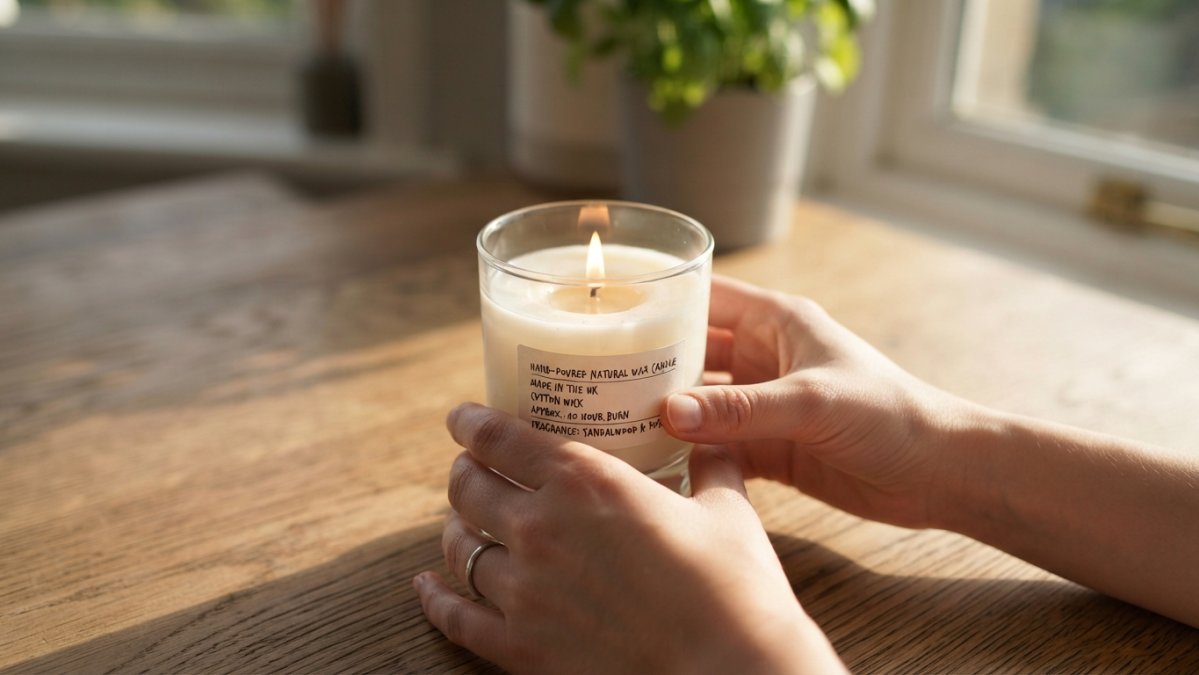
If you want to run this checklist against real products, a mixed fragrance candle set lets you compare wicks, wax and scent performance side by side before committing to a full-size jar.
Choosing a Candle You Can Actually Trust
A trustworthy candle is one whose maker can answer every question on that checklist without reaching for adjectives.
Around 95% of our raw materials are sourced in the UK, our packaging is recyclable, and our diffusers use an alcohol-free formula.
Fake sustainable candles rely on you not asking. If you would like to see the difference for yourself, browse our sustainable luxury home fragrance collection or start with a Midnight Library three-wick candle and put the checklist to work.
The gap between a candle that claims to be sustainable and one that can prove it comes down to disclosure.
Frequently Asked Questions
How can you tell if a candle is genuinely sustainable?
Look for specifics rather than slogans. A genuine sustainable candle names its wax (for example 100% natural soy and rapeseed), states a tested burn time that varies sensibly by size, and describes the wick material. Check whether the seller explains a testing process, such as burning the candle through and checking scent throw at intervals. Vague wording like natural-based or eco-friendly without percentages or ingredient detail is a warning sign. Reviews that describe the lit candle, including scent throw and even burn to the edge, are more useful than unboxing photos.
What does candle greenwashing look like in practice?
Candle greenwashing usually appears as unqualified adjectives: clean, eco, natural, non-toxic. None of these have a fixed legal definition on a candle label, so they can be used freely. Stronger signals include a stated wax blend with percentages, a named fragrance disclosure, and packaging that explains how to recycle or reuse the container. If a brand claims a burn time without saying it was tested by burning, treat the figure as a calculation rather than a measurement.
Which candle wax is the most sustainable?
There is no single winner. Plant-based waxes such as soy, rapeseed and coconut are renewable, but their footprint depends on where the crop was grown, how it was refined and how far it travelled. Beeswax is a by-product of beekeeping, though supply is limited. Paraffin is petroleum-derived and not renewable. A blend combines waxes with different burn characteristics. Ask what the blend contains and whether the wax was refined in-house, since that affects both quality control and transport.
Are soy candles always better for the environment?
No. Soy is renewable, but a soy candle can still be shipped long distances, poured into non-recyclable packaging, or scented with poorly disclosed synthetic fragrance. A soy candle that tunnels and leaves half the wax unused is also wasteful. Judge the whole product: wax sourcing, wick testing, fragrance disclosure, packaging and end-of-life instructions.
What candle ingredients should I avoid?
Be cautious with candles that list no ingredients at all, or that use vague terms like fragrance oils without further detail. Look out for wicks whose materials are not clearly described. Over-scented candles can smell strong in the jar but burn badly, sweat or soot. If a brand cannot tell you what the wick is made of or whether the fragrance was tested lit, that is a reason to keep looking.
Is a candle in a glass jar more sustainable?
A glass jar is only more sustainable if it is reused or recycled. Many glass candle jars can be cleaned out and used for storage, and glass is widely recycled in household collections. Check whether the brand gives end-of-life instructions, such as how to remove leftover wax before recycling. Packaging matters too: recyclable or compostable outer packaging and minimal plastic reduce the impact. A refillable candle system avoids the container entirely and is worth asking about.
How can I check whether a candle fragrance is safe?
Ask whether the fragrance was tested in the lit candle, not just sniffed from the jar. Cold throw and hot throw are different: a candle can smell great unlit yet give off little scent once burning. A seller who states a testing process and gives specific burn times, such as 180g candles averaging about 45 hours, is showing their working. Black marks on the glass or a sooty smell usually mean the flame is not burning efficiently, which points to a wick that is too large for the wax.
